January 16, 2016 • qnib • 4 min read
Consul Ambassador Pattern
Did I mention I love Open-Source software? I do - I really do! :) Using a pull request on Consul, I get closer to a nice setup: github isse
So what I am talking about here? As you readers should already know I use Consul as the backend for my service/node discovery stuff and user related topics.
NAT
Let’s assume we got three containers (int{1..3}) within a DC which is accessible to other DC going through a load-balancer (server). An external node (ext0) has no direct access to the internal network.
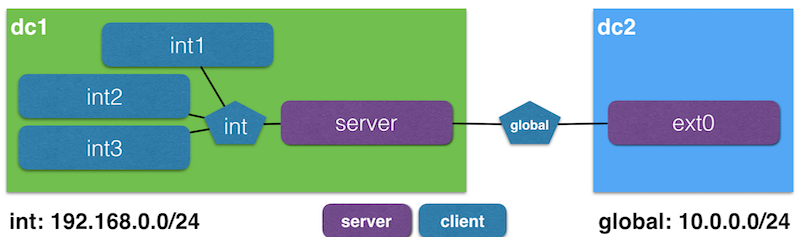
The purple boxes are Consul agents running as server, the others are simple clients.
Start the stack
$ sh start.sh
## Networks
[global] > docker network inspect global >/dev/null                        > exists?
[global] > already there (SUB: "10.0.0.0/24")
[int] > docker network inspect int >/dev/null                              > exists?
[int] > already there (SUB: "192.168.1.0/24")
#### Start stack
[server]         > docker-compose up -d server                  > Start
Creating server
[server]         > docker network connect int server            > Connect to int network
[server]         > docker exec -ti server  ip -o -4 addr        > Display ip addresses
1: lo    inet 127.0.0.1/8 scope host lo\       valid_lft forever preferred_lft forever
652: eth0    inet 10.0.0.2/24 scope global eth0\       valid_lft forever preferred_lft forever
654: eth1    inet 192.168.1.2/24 scope global eth1\       valid_lft forever preferred_lft forever
[ext0,int{1..3}] > docker-compose up -d ext0 int1 int2 int3     > Start
Creating ext0
Creating int1
Creating int3
Creating int2
$
Look at what we’ve done
Within DC1 the members look like this:
$ docker exec -ti server consul members
Node    Address           Status  Type    Build  Protocol  DC
int1    192.168.1.3:8301  alive   client  0.6.0  2         dc1
int2    192.168.1.5:8301  alive   client  0.6.0  2         dc1
int3    192.168.1.4:8301  alive   client  0.6.0  2         dc1
server  10.0.0.2:8301     alive   server  0.6.0  2         dc1
$
ext0 is connected only to server as a WAN-buddy:
$ docker exec -ti server consul members -wan
Node        Address        Status  Type    Build  Protocol  DC
ext0.dc2    10.0.0.3:8302  alive   server  0.6.0  2         dc2
server.dc1  10.0.0.2:8302  alive   server  0.6.0  2         dc1
$
But, ext0 uses WAN addresses instead of internal addresses to resolve names:
$ docker exec -ti ext0 grep translate /etc/consul.json
    "translate_wan_addrs": true,
$
The setup has the following WAN addresses configured:
- int1:
""Default behaviour - int2:
"8.8.8.8"As if the container is a placeholder for an external service - int3:
"10.0.0.2"As if the container is hidden behind a load-balancer
Therefore pinging the host, leads to different outcomes.
Int1
This container is not reachable, since the network is not routed:
$ docker exec -ti ext0 ping -w1 -c1 int1.node.dc1.consul
PING int1.node.dc1.consul (192.168.1.3) 56(84) bytes of data.

--- int1.node.dc1.consul ping statistics ---
1 packets transmitted, 0 received, 100% packet loss, time 0ms
$
Int2
Nice as a placeholder for not yet containerised external services.
$ docker exec -ti ext0 ping -w1 -c1 int2.node.dc1.consul
PING int2.node.dc1.consul (8.8.8.8) 56(84) bytes of data.
64 bytes from google-public-dns-a.google.com (8.8.8.8): icmp_seq=1 ttl=61 time=48.7 ms

--- int2.node.dc1.consul ping statistics ---
1 packets transmitted, 1 received, 0% packet loss, time 0ms
rtt min/avg/max/mdev = 48.788/48.788/48.788/0.000 ms
$
Int3
int3 might be a web server behind the loadbalancer (or NAT) server.
$ docker exec -ti ext0 ping -w1 -c1 int3.node.dc1.consul
PING int3.node.dc1.consul (10.0.0.2) 56(84) bytes of data.
64 bytes from server (10.0.0.2): icmp_seq=1 ttl=64 time=0.100 ms

--- int3.node.dc1.consul ping statistics ---
1 packets transmitted, 1 received, 0% packet loss, time 0ms
rtt min/avg/max/mdev = 0.100/0.100/0.100/0.000 ms
$
Problems
For now it’s a bit brittle, since the agent is only able to bind to one interface. If I would swap the network of server, so that it initially connects to int and afterwards to global, the setup does not work.
There is an issue open to smoke that out: #1620, which references to this PR at nomad #223.
If this is fixed it should be more stable.
Conclusion
We are getting there, if this is moved over to consul-template, it would be possible to model all external services as consul agents.
Furthermore address backend nodes (web-server) behind a load-balancer and resolve to the load-balancer in charge. Which would round-robin according to the amount of back-end services.